AI & Machine Learning Hiring Trends - Q1 2026 (UK vs US)
16th March, 2026 5 minutes
AI hiring conversations look very different today compared with even two years ago.
Many organisations are moving from small experimental teams to production AI systems, resulting in a growing demand for machine learning engineers, MLOps specialists and AI platform engineers across both the UK and US.
Here’s what we’re seeing in the market, the roles companies are prioritising, and what both employers and candidates should keep in mind.
Key AI Hiring Trends in 2026
AI teams are moving from experimentation to production systems
Demand is growing for engineers who can deploy and operate machine learning in real environments
AI roles are becoming more specialised, particularly across ML engineering, MLOps and AI infrastructure
Engineers with production ML experience remain difficult to hire
Salary matters, but the technical environment often influences final hiring decisions
Together, these trends reflect how organisations are building AI capability directly into products and platforms. This shift becomes clearer when you look at how AI teams are now structured.
How Companies Are Building Production AI Teams
A few years ago, many teams focused on experimentation: building models, testing ideas, and running proof-of-concept projects.
Now the focus is different. Companies are asking practical questions:
How do we deploy models reliably?
How do we scale them across products and platforms?
How do we monitor performance once they’re live?
As of the Stanford AI Index, investment in AI continues to grow. In 2024 alone, U.S. private AI investment reached $109.1 billion, significantly outpacing other regions.
At the same time, research from McKinsey’s Global Tech Agenda shows AI has become one of the most common technology investment priorities for CIOs.
All this data points to a steady need for engineers who can deploy and maintain AI systems in production.
How do we scale these systems and the teams supporting them without slowing delivery?
Why Hiring Experienced AI Engineers Is Still Difficult
From conversations we have with clients, hiring AI and ML talent can feel like a maze. Roles like data engineer and MLOps engineer often work closely together, but their skills and priorities aren’t actually the same.
Part of the challenge is also timing. Many organisations are investing in AI capability at the same time, which naturally increases competition for the same pool of engineers.
Experience also makes a big difference in this market. Many companies are looking for people who have already deployed machine learning systems into production environments. That kind of experience is still relatively limited.
The roles themselves are also becoming more specialised.
Areas like generative AI, large language model integration and machine learning operations (MLOps) have created new types of engineering roles. When companies look for candidates who have worked in those environments before, the talent pool becomes even smaller.
AI Skills Companies Are Hiring For in 2026
Another change in the AI hiring market is the mix of skills companies are looking for.
Earlier hiring cycles focused heavily on model development and research. Today the priority is often different. Companies want engineers who can connect AI models to real systems and products.
Some of the skills we’re seeing most often in AI hiring briefs include:
Machine learning infrastructure and deployment
Model monitoring and lifecycle management
AI platform engineering
Large language model (LLM) integration
Responsible AI and governance
UK vs US AI Hiring Markets
The UK and US both have active AI hiring markets, but the scale is very different.
The US continues to dominate global AI investment and research output, which naturally drives a larger hiring market. That level of investment drives demand for engineers across AI startups, big tech companies and enterprise teams.
The UK operates on a smaller scale but remains one of the most active AI ecosystems in Europe. London in particular continues to attract investment in sectors such as fintech, health technology and enterprise software.
AI Market Snapshot
Metric | United States | United Kingdom |
Private AI Investment (2024) | $109.1 billion | $4.5 billion |
AI Investment Rank (Global) | 1st | 3rd |
Organisations Using AI (2024) | 78% globally (AI Index benchmark) | Similar adoption across enterprise sectors |
AI Hiring Demand | Highest globally across big tech, startups and enterprise | Strong demand concentrated in fintech, healthtech and enterprise SaaS |
Key AI Hubs | San Francisco, New York, Seattle, Austin | London, Cambridge, Manchester |
Sources: Stanford AI Index 2025, CIO IT Hiring Research
Why This Matters for AI Hiring
For companies building AI teams, location influences how competitive hiring becomes.
In the US, the challenge often comes from the sheer scale of demand, with major technology companies, startups and enterprise organisations competing for the same engineers.
In the UK, competition is often more concentrated. A smaller talent pool combined with strong demand from fast-growing technology companies can make experienced AI engineers difficult to secure.
For hiring leaders, understanding these market dynamics helps set realistic expectations around hiring timelines, salary benchmarks and talent availability.
Will Higher Salaries Secure AI Talent?
In conversations we have with both clients and candidates, salary is only part of the story.
Engineers who have built and deployed machine learning systems look closely at the environment they’re joining. They want to understand the technical challenges of the role, how mature the company’s AI infrastructure is and whether there’s a clear plan for how AI will be used across the business.
That doesn’t mean compensation isn’t important.
Hiring research shows salaries for machine learning and AI engineering roles continue to grow slightly faster than many other software roles. Some industry benchmarks project average salary increases of around 4% for AI and ML roles, reflecting continued demand for these skills.
Research cited in CIO hiring reports also shows 87% of IT leaders are willing to increase starting salaries when hiring candidates with specialist skills, particularly in areas such as AI, cybersecurity and cloud infrastructure.
Salary expectations also vary significantly depending on experience with production ML systems, infrastructure platforms and large-scale data environments.
What This Means for AI Hiring
When companies hire AI talent and engineers explore new roles, three things usually shape the outcome.
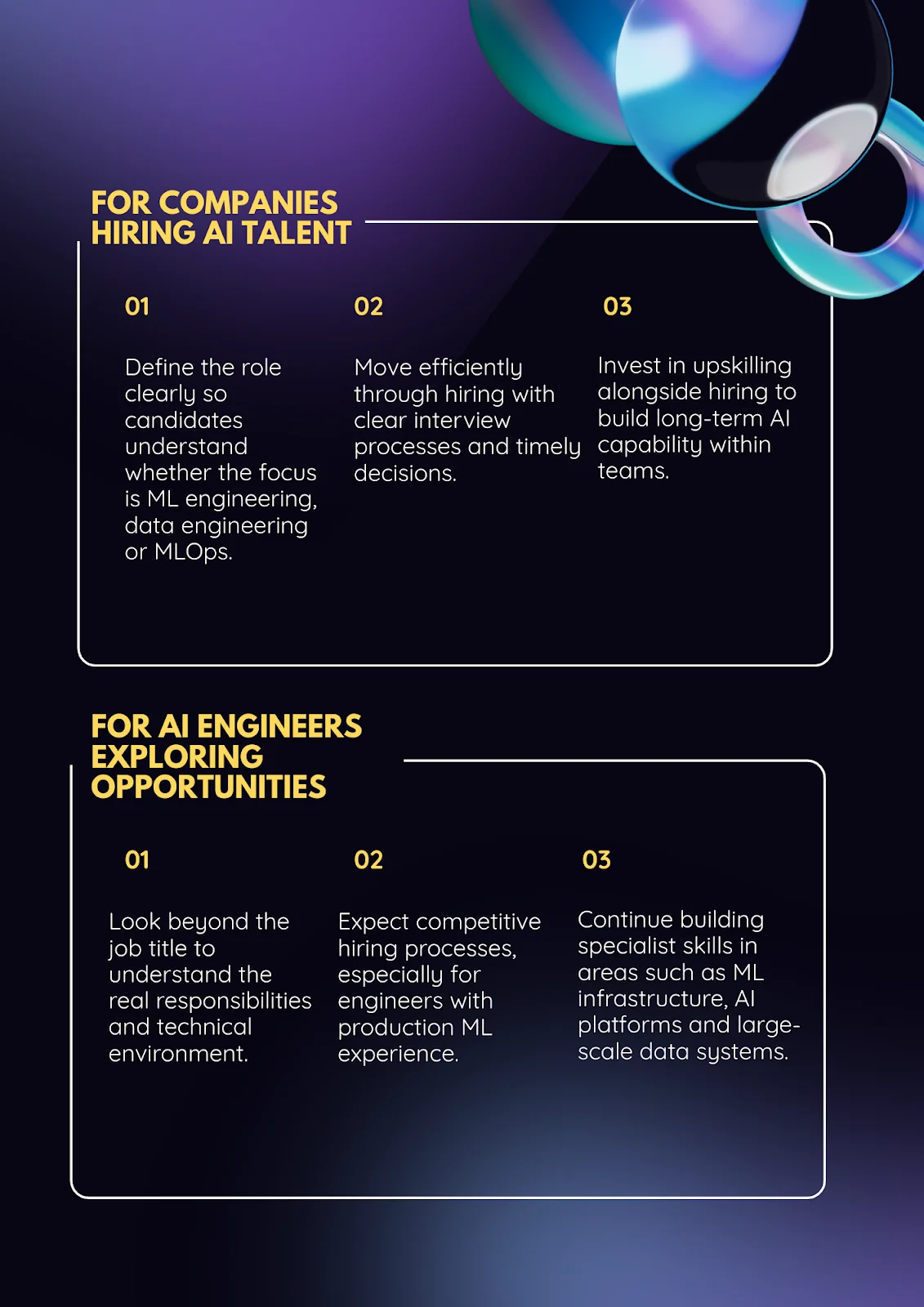
For hiring teams, clarity and speed often make the biggest difference in securing strong candidates. For engineers, understanding the real scope of a role and continuing to build specialist expertise can shape long-term opportunities in the AI market.
Considering Your Next Move?
Whether you’re building AI capability or thinking about your next role in the market, understanding how teams are structured and what companies are really looking for makes a big difference.
For hiring leaders, that often starts with defining the role clearly and building a team environment where engineers can contribute meaningfully.
For engineers, it means looking beyond the job title and understanding the problems a team is solving and how AI fits into the wider product.
If you’re exploring either side of that conversation, you can connect with Dale Swords at Understanding Recruitment to discuss AI hiring strategy or opportunities in the market.